Identity · Burnout Recovery · Reinvention
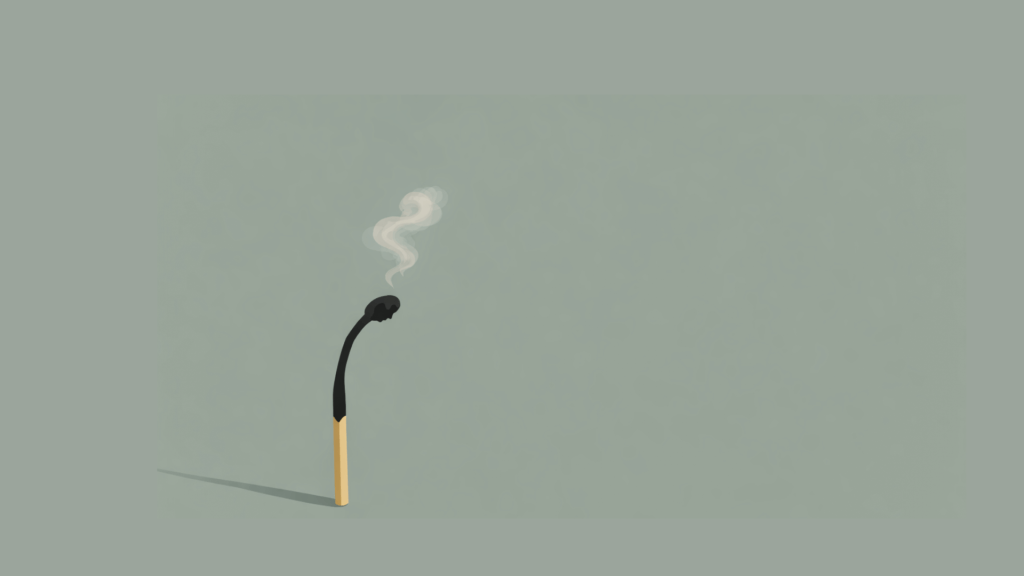
There’s a version of burnout everyone recognises. The exhaustion, the dread, the inability to switch off. But there’s another version that’s harder to name. The one that quietly dismantles your sense of self.
Burnout doesn’t just drain your energy, it quietly erodes the story you’ve been telling yourself about who you are. This is what it does to your identity, and how you begin to come back to yourself.
When I stepped away from my job, I thought the hardest part would be the practical things, the income gap, the CV gap, the explaining. But the hardest part was waking up without a role to step into. I had been someone who was capable, reliable, driven. Someone people could count on. I didn’t realize how much of my identity I had outsourced to that version of myself until she was gone.
The thing no one tells you about burnout
Burnout forces you into a kind of identity amnesia. You stop trusting your judgment because your judgment told you to keep going. You stop feeling capable because capable people, you tell yourself, don’t end up here. You lose the structure that once told you who you were.
And then you’re left with yourself, which sounds peaceful in theory, but in practice feels like standing in an empty room being asked to redecorate without knowing what you like anymore.
For a long time, I tried to recover by doing. Updating my CV. Researching courses. Staying productive enough to feel okay about myself. But that was just another version of the identity I was trying to leave behind.
The real work was sitting with the questions I had avoided for years:
Who am I when I’m not performing competence?
What do I value when no one is rewarding me for it?
What kind of life would I choose if I wasn’t afraid of failing?
These questions don’t have quick answers. But asking them at all was the beginning of something.
The Change Cycle Nobody Warns You About
Here’s what I’ve come to understand about recovery and about change in general: it isn’t linear, and it follows a pattern that most people hit without knowing it exists.
You feel discontent. Something breaks. You make a decision. You act. And then, almost predictably, fear arrives. Not the kind that means you’re doing something wrong. The kind that means you’re doing something real.
What nobody tells you is that this fear has a specific pattern. Your brain starts looking for the exit, and the exit it finds is nearly always the past. Suddenly the thing you left doesn’t seem so bad. The job was stressful, sure, but at least it was stable. And before you know it, you have a very convincing case for going back, and every word of it sounds like common sense.
This is what I now know is called change amnesia. And I have done it more times than I want to admit. The moment things got uncomfortable enough, I would quietly start rewriting the past. Making it softer. More manageable. Wondering if I had overreacted.
The last stage, if you let the amnesia win, is backtracking. Returning to what was familiar. And the cruelest part is that it does not feel like giving up. It feels like coming to your senses.
What changed wasn’t that the fear went away. It’s that I started to recognize it.
Naming it doesn’t make it comfortable. But it makes it survivable.
What actually helped
Coming back from a burnout hasn’t been linear. Some days feel like progress. Some days feel like I’m back at the beginning. The difference is I’ve stopped expecting the progress to be straight.
What has helped, not fixed, but helped:
Rebuilding structure before motivation.
Motivation is unreliable when you’re recovering. Structure isn’t. The gym at the same time every morning. Breakfast with my partner and son. Writing something, even if no one reads it yet. These things don’t require me to feel ready. They just require me to show up.
Separating identity from productivity.
My worth isn’t measured in output, even if my brain still tries to convince me otherwise. This one takes practice. I’m still practicing.
Letting reinvention be slow.
Rushing into a new identity before understanding the old one only recreates the same patterns. I spent years as someone who was excellent at being what other people needed. Building something that actually fits me takes longer, and that’s fine.
Staying close to the things that feel like me.
The gym. Cooking. Writing. The things that existed before burnout, before achievement, before identity became performance.
Where I am now
The woman I’m becoming is more intentional, more honest, and more willing to build a life that fits her, not the other way around.
I’m not there yet. But I’ve stopped waiting to feel certain before I move. Certainty, I’ve learned, comes after the action, not before it.
If you’re in the middle of your own burnout recovery and feel like you’ve lost track of who you are that’s not failure. It might be the first honest look you’ve had at yourself in a long time.
That’s where the real work starts.

